AI View of – “God Never Said Obedience Would be Easy” by Pastor Joy Matos – 09.20.2026
1. Summary
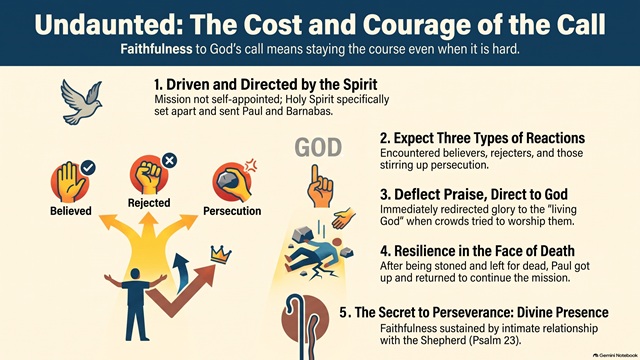
Paul and Barnabas followed God’s call. They traveled to many cities. They told people about Jesus. Some people believed their words. Other people grew angry. These people tried to hurt the men. Paul was stoned and left for dead. He got up and went back to work. He did not quit. The Holy Spirit gave them strength. God is always with His people. Following God is hard. He helps us stay faithful.
2. Sermon
The Three Responses to Truth
The sermon observes a recurring pattern in the synagogues of Iconium and beyond. Whenever the Truth is presented, the audience inevitably fractures into three distinct groups:
- The Believers: Those who receive the message effectively and transition into discipleship.
- The Rejectors: Those who simply refuse to believe the message.
- The Agitators: Those who go beyond personal rejection to actively “poison the minds” of others and stir up trouble for the messengers. Recognizing these categories recalibrates the believer’s expectations, moving them away from the shock of opposition and toward a state of spiritual readiness.
Expectation vs. Reality
The sermon confronts the modern assumption that divine calling guarantees “100% success” or a path free of obstacles. Matos utilizes Matthew-10 to highlight Jesus’s own warnings, specifically the distinction of “when” – not “if” – the disciples would face arrest. She further exposes the extreme volatility of the mission field by highlighting the “fickle crowd” of Lystra. These people transitioned instantly from deifying the apostles as Zeus and Hermes to participating in the stoning of Paul. This narrative demystifies suffering, positioning it as a confirmed element of the journey that Jesus explicitly prepared His followers to navigate.
Undaunted Resilience
The actions of Paul and Barnabas dissect the nature of supernatural stamina. While they used wisdom to flee the initial plot in Iconium, the sermon focuses on the brutal reality of Lystra, where Paul was actually stoned and left for dead. His decision to get up and immediately re-enter the city validates the idea that resilience is a product of divine empowerment rather than human willpower. This reframes the mission not as a search for safety, but as a commitment to the “good news” that continues regardless of the physical cost to the messenger.
3. Ai Opinion
Pastor Joy Matos’s sermon is highly effective because of its rigorous intertextual weaving. She successfully connects the Acts narrative with the modern-day testimonies found in The Voice of the Martyrs, as well as the poetic comfort of Psalm 23. By incorporating the perspective of Dr. Bob Pierce, founder of World Vision, she echoes the challenging sentiment that “others have done so much with so little while we have done so little with so much.” This, alongside references to the scholarly work of Warren Wiersbe, prevents the biblical text from feeling like a distant myth. Linking the stoning of Paul to the “valley of the shadow of death” provides a profound emotional anchor for a modern audience.
The strength of this message lies in its unwavering honesty about the cost of faith, anchored by the definitive scriptural text of the day.
4. Primary Scriptural Pillar
The one line from the Acts 14:1–7 reading that most accurately reflects the sermon’s title and core message is:
“But they continued to preach the gospel.” (Acts 14:7)