
“Ai View of – ‘When Disagreements Happen –Part 2’ by Pastor Joy Matos – 09.27.2026”
1. Summary
In this sermon Pastor Joy Matos explains how the early Christian church resolved a major internal conflict regarding non-Jewish believers. By examining key events in the biblical book of Acts, the sermon demonstrates that early church leaders successfully navigated intense disagreements by listening to one another for understanding, identifying shared underlying goals, and ultimately submitting their decision-making to the guidance of the Holy Spirit.
2. Sermon Explainer
The Historical Context (Acts 10 & 11)
The structural framework for resolving church disputes began with Peter’s experiences in Acts 10 and 11. Initially, early Christian disciples focused their ministry exclusively on Jewish populations. However, God granted a divine vision to Cornelius, a God-fearing Roman centurion, instructing him to send for Peter. Simultaneously, while praying on a rooftop in Joppa, Peter experienced a vision of a large sheet lowered from heaven containing various animals deemed unclean by Mosaic law, accompanied by a divine command: “Do not call anything impure that God has made clean.”
When Cornelius’s messengers arrived, Peter accompanied them to Caesarea and preached the gospel to Cornelius’s entire Gentile household, who immediately received the Holy Spirit. Upon Peter’s return to Jerusalem in Acts 11, circumcised Jewish believers criticized him for eating with uncircumcised Gentiles—an act prohibited by Mosaic custom. Peter defended his actions by explaining that God had imparted the identical gift of the Holy Spirit to the Gentiles as He had to Jewish believers. Realizing God’s direct initiative, the critics ceased their objections and praised God for granting Gentiles the opportunity for repentance and eternal life.
The Conflict at Antioch (Acts 15)
A decade later, as the church in Antioch grew into what scholar F.F. Bruce termed “the metropolis of Gentile Christianity,” a severe dispute emerged. Men from Judea arrived in Antioch teaching that Gentile believers could not be saved unless they were circumcised and kept the Law of Moses. As New Testament scholar Merrill Tenney observed, the reception of these Gentiles precipitated a fundamental question that haunted the growing body of believers: was legal observance the final criteria for righteousness and a right relationship with God, or was faith in Christ sufficient?
Paul and Barnabas engaged in sharp dispute with these Judean teachers, maintaining that salvation is a gift of God’s grace received through faith alone. Recognizing that two opposing factions holding fundamentally conflicting requirements for salvation could not co-exist without fracturing the church, the Antioch congregation appointed Paul, Barnabas, and several believers to travel to the Jerusalem Council to resolve the matter with the apostles and elders.
Analytical Lens – Positions vs. Interests
To evaluate the Jerusalem Council’s decision-making process, Pastor Joy applies the negotiation framework articulated by Roger Fisher and William Ury in their classic work, Getting to Yes: Negotiating Agreement Without Giving In. Fisher and Ury argue that sustainable conflict resolution requires parties to move beyond rigid positions (what each side demands) and focus instead on underlying interests (what each side truly needs).
This principle is illustrated by the 1978 Camp David peace treaty between Egypt and Israel:
- Positions: Israel insisted on maintaining control over parts of the Sinai Peninsula, while Egypt demanded full sovereignty over every inch of the land. Geographic compromises drawing intermediate boundary lines consistently failed because both sides remained locked into their demands.
- Interests: When analyzing underlying needs, negotiators realized Israel’s primary interest was security (guaranteeing safety from military attack), whereas Egypt’s primary interest was sovereignty (reclaiming national territory).
- Resolution: The final agreement returned the Sinai Peninsula to full Egyptian sovereignty while demilitarizing large stretches of the territory to guarantee Israeli security—satisfying the vital interests of both nations without forcing either to abandon its essential need.
Pastor Joy applies this analytical lens directly to the Jerusalem Council:
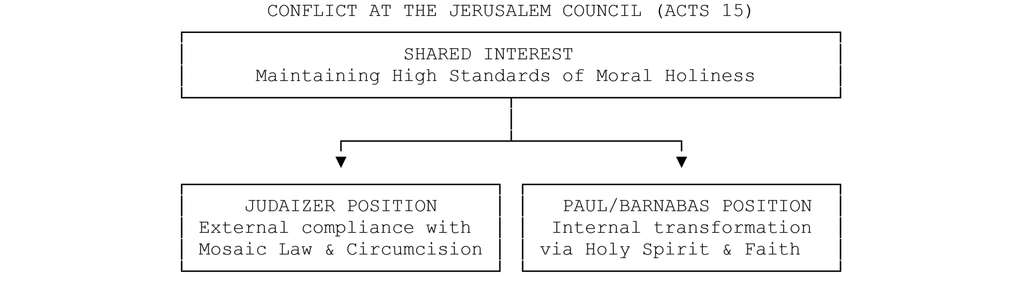
- Rigid Positions: The Judaizers insisted that Gentiles must undergo circumcision and obey the Mosaic Law to participate in Christian fellowship and the Lord’s Supper. Conversely, Paul and Barnabas maintained that salvation required faith in Christ alone, completely unencumbered by Mosaic legalism.
- Shared Interests: As scholar F.F. Bruce notes, Jewish Christians feared that an influx of Gentile believers would lower moral standards through prevailing Gentile practices like idolatry and sexual immorality. Paul shared this exact interest in maintaining high moral character. In Galatians 5, Paul explicitly contrasts the destructive behaviors of the sinful nature (e.g., sexual immorality, idolatry, hostility, dissension) with Spirit-led living. Both factions desired high standards of holiness; Judaizers sought to enforce it through external compliance with Mosaic Law, whereas Paul argued that the indwelling Holy Spirit naturally regulates believer behavior from within.
CONFLICT AT THE JERUSALEM COUNCIL (ACTS 15)
The Divine Differentiator
While secular negotiation models focus entirely on aligning human interests to reach a compromise, Christian conflict resolution introduces a higher dimension: divine submission. The Jerusalem Council did not merely negotiate a human consensus; they prioritized the active, sovereign leadership of God. As F.F. Bruce observes, the church functions uniquely as the “vehicle of the Spirit.” The council members were so conscious of being guided by God that they assigned primary authorship of their final decree to the Holy Spirit, famously declaring, “It seemed good to the Holy Spirit and to us.”
The Council’s Resolution
Following extensive discussion, listening to Peter, Paul, and Barnabas, James addressed the assembly by aligning their experience with Old Testament scripture. He quoted the prophet Amos, who foretold that God would rebuild “David’s fallen tent” so that the remnant of humanity and all Gentiles called by His name might seek the Lord.
To facilitate complete table fellowship between Jewish and Gentile believers without placing unnecessary legal burdens on Gentiles, James proposed four specific guidelines:
- Abstain from food polluted by or sacrificed to idols.
- Abstain from sexual immorality.
- Abstain from the meat of strangled animals.
- Abstain from consuming blood.
Pastor Joy notes that table fellowship in the early church carried massive social weight, analogous to modern church potlucks. Because Jewish believers maintained strict dietary laws to avoid idolatrous meat, these four behavioral and dietary accommodations allowed Gentile Christians to demonstrate loving concern for their Jewish brothers and sisters. By agreeing on these practical boundaries, Jewish and Gentile Christians could share meals and holy communion together in unity. The council drafted a formal letter containing these guidelines and dispatched Judas and Silas alongside Paul and Barnabas to deliver it to Antioch and surrounding churches, restoring peace, fellowship, and organizational unity across the expanding church.
3. Ai’s Critical Assessment and Opinion of the Sermon
Pastor Joy’s teaching effectively bridges ancient scripture with modern negotiation theory. By integrating Fisher and Ury’s Getting to Yes framework—specifically through the historical lens of the 1978 Camp David Accords—she transforms a potentially dense theological debate in Acts 15 into a highly practical model for interpersonal and organizational conflict resolution. Furthermore, by framing the conflict through Galatians 5, her analysis demonstrates that true biblical resolution replaces rigid external rule enforcement with internal spiritual regulation driven by the indwelling Holy Spirit.
The primary strength of the sermon lies in her articulation of the “Divine Differentiator.” While secular negotiation models aim merely to align conflicting human interests into a mutually acceptable compromise, Pastor Joy demonstrates that biblical resolution demands absolute submission to the Holy Spirit. By showing that unity was achieved when church leaders prioritized God’s will over personal positions, her message transcends standard dispute-management techniques and offers a distinctively Christian approach to organizational harmony.
4. Primary Textual Anchor: “It seemed good to the Holy Spirit and to us…” Acts 15:28
This single statement captures the core thesis of Pastor Joy’s teaching on resolving Christian disagreements. It demonstrates that true church resolution requires human alignment (“and to us”) to be completely subordinated to divine guidance (“It seemed good to the Holy Spirit”). By placing the Holy Spirit as the primary author of the decision, this verse anchors the sermon’s central message: believers resolve conflict not through self-interest or sheer human negotiation, but by listening to one another and yielding to the authority of God.