Chapter Two
An Analysis of "The Way of the Covenant People"
1.0 A Comprehensive Review of the Chapter
1.1 Introduction: The Search for a Congregational Identity
This chapter addresses a perceived crisis of identity among mid-twentieth-century American Congregationalists. The author posits that despite a rich history forged in conviction and controversy, contemporary members often struggle to articulate the unique tenets and purpose of their faith. While they can identify what Congregationalism is not governed by popes or bishops they lack a positive, compelling answer to the question of what it is. The chapter s strategic importance lies in its call to move beyond a simple and vague definition of "freedom" toward a more profound, historically grounded understanding of their identity as a "covenant people," which the author presents as the core of the Congregational Way.
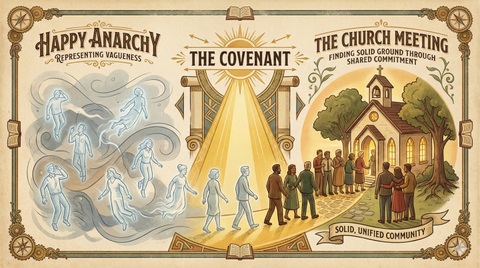
1.2 The Problem of "Happy Anarchy": A Vague Definition of Freedom
The central problem identified by the author is a pervasive "sense of vagueness" that leaves many Congregationalists feeling their faith is "wanting." They frequently define themselves by what they lack "no popes, no bishops, no ecclesiastical controls" rather than by a positive assertion of belief. This ambiguity stands in contrast to the clearer identities of other denominations: Rome has its pope, Episcopalians have apostolic succession, Methodists have their evangelical fervor, and Baptists have their stance on baptism. In the absence of a shared, positive understanding, freedom is often tragically misinterpreted. The author diagnoses this not as mere vagueness, but as a misguided belief that the Congregational Way is "an anarchy of the spirit the religious incarnation of democratic individualism." This leaves many, especially young people, with the inadequate answer that "We are the free churches. Here you can do and believe as you like," fostering a spiritual malaise that searches for more solid ground.
1.3 The Core Thesis: Rediscovering the "Covenant People"
The author s central solution to this identity crisis is the rediscovery of what it means to be a "covenant people." This concept is presented not as a creedal test, but as a profound, personal commitment to follow Christ. The author draws a sharp distinction: whereas creeds demand intellectual assent "Believe these items of theology and you are in!" as with the Apostles’ Creed the covenant is a response to Jesus’s direct call, "Follow Me." Its theological foundation is His promise, "Where two or three are gathered together in My Name, there am I in the midst of them." This covenant provides the discipline, authority, and strength that seem to be missing, rooting them not in human hierarchies or canon laws but in the direct, living presence of Christ, who rules as "Lord and King" within the gathered community. This covenantal relationship is presented as the foundational principle of the Congregational Way.
1.4 The Covenant in Practice: The Role of the Church Meeting
The practical, lived expression of the covenant is the "Church Meeting," described as " the unique institution in Congregationalism." This is where the community collectively seeks to discern and enact God’s will. It is a form of worship, not a standard business meeting. To illustrate this principle, the author recounts a powerful anecdote about a contentious meeting in Williamsburg concerning the construction of a much-needed Sunday School. The meeting was fierce, the vestry crowded with all shades of opinion. Yet it began and ended in prayer. In the interim, after all sides were heard, a unanimous decision to build was reached, convincing even those who had initially come "to blast the whole idea." This outcome, which felt divinely inspired, exemplifies the core conviction of the Church Meeting: that Christ is present and guiding the community to a unified will. This belief underpins the tradition of seeking unanimity, for as the author posits, "If a given decision is Christ’s will, then it is His will for all the people. It is not something that can be divided."
1.5 The Call to Commitment: The True Cost of Congregationalism
The author concludes with a powerful argument that becoming a Congregationalist must be a deliberate, meaningful, and even "difficult" act of commitment, as it was never meant to be the "easy way." To underscore this point, the text highlights the significant historical sacrifices made by Congregationalists in Great Britain. There, they were a minority forced to pay taxes to the State Church, were often denied burial in Anglican churchyards, and were barred from Oxford and Cambridge Universities until 1870. The author contrasts this with the modern American experience, particularly in Massachusetts, where Congregational churches are often "the most influential of the Protestant denominations," and membership brings "respect, prestige, prosperity." Without the tension of decision and sacrifice, the commitment risks becoming hollow. The obligations and privileges of the Congregational Way only become "concrete and alive" when prospective members are given the time for prayer, study, and a conscious decision to truly "own" the covenant they are entering into.
2.0 Key Questions and Answers
This section clarifies the chapter’s main points through a series of concise questions and answers based on the provided text.
- What is the main problem facing Congregationalists according to the author? The main problem is a sense of vagueness and weak theological identity, which stems from misinterpreting freedom as an "anarchy of the spirit." Congregationalists tend to define themselves by the absence of ecclesiastical controls, which leaves many members, especially the young, feeling their faith is "wanting."
- How does the author define the "covenant" that is central to Congregationalism? The author defines the covenant not as a creed requiring belief in specific doctrines, but as a personal commitment to answer Christ’s call to "Follow Me." It is based on His promise to be present wherever "two or three are gathered" in His name, and this agreement forms the church and provides its authority.
- What makes the "Church Meeting" unique in the Congregational Way? The Church Meeting is unique because it is treated as a form of worship, not a secular business meeting. It is the institution where the covenant is lived out, as the congregation gathers with the expectation that the Holy Spirit will speak through any member to reveal Christ’s unified will for the community.
- Why does the author argue that joining a Congregational church should not be "easy"? The author argues that joining should not be easy because the Congregational Way is built on a serious, life-changing commitment to "own" a covenant. This contrasts with the historical sacrifices made by Congregationalists, making it vital that modern membership be a deliberate act of study, prayer, and decision.
- What is the source of authority and discipline in Congregationalism? The source of authority and discipline is the direct, unmediated presence of Jesus Christ in the gathered church. As "Lord and King," He rules the local congregation, exercising his authority through the Holy Spirit in the Church Meeting without need for popes, bishops, or presbyters.
3.0 Glossary of Key Terms
This glossary defines key terms as they are understood and utilized within the specific context of this chapter.
- Congregational Way: A way of church life centered on the concept of being a "covenant people," where the local church is governed directly by Christ, and its discipline and authority derive from His presence in the gathered community.
- Covenant People: A term for Congregationalists, describing them as a community whose identity and strength come from a shared, personal commitment to follow Christ and live in a binding relationship with Him and each other.
- Free Church: A church that operates without external ecclesiastical controls, such as popes or bishops, where the local congregation orders its own affairs under the direct authority of Christ.
- Church Meeting: The primary and unique institution of Congregationalism where the entire local congregation gathers for worship and to discern the will of Christ for their community, distinct from a secular business meeting.
- Happy Anarchy: A descriptive phrase for the perceived state of Congregationalism when its members misinterpret freedom as a lack of rules and theological grounding, or as "the religious incarnation of democratic individualism."
- Covenant (Theological Concept): An agreement between God and humanity. The author distinguishes between the "Old Covenant" God made with Israel and the "New Covenant" established through Jesus Christ, which is not a theological test but a personal commitment to follow Him based on His promise to be present with his people.
4.0 Analysis of the Author’s Intent
The author’s primary intent in this chapter appears to be threefold. First, it serves as a pastoral call to action, urging Congregationalists to move beyond a state of spiritual complacency and theological vagueness that threatens the vitality of their denomination. Second, the chapter functions as an educational tool, seeking to reconnect a generation of church members with the profound theological heritage of the "covenant" that the author believes they have forgotten or misunderstood. Finally, the author aims to re-frame the concept of freedom, transforming it from a negative definition an absence of external rules into a positive and profound discipline: the disciplined commitment to live under the direct authority of the living Christ within the community. Ultimately, the author intends to inspire a revitalization of the church by grounding it more deeply in its core principle of the covenant.